Company Registration in Singapore - The Complete Guide 2026

Thinking of incorporating a company in Singapore? You’re in the right place.
With its strategic location, low corporate tax rate (capped at 17%), strong intellectual property protection, and a suite of government grants for startups and SMEs, Singapore continues to be one of the world’s most business-friendly economies.
In fact, over 60,000 business entities were registered in 2025, an average of over 5,000 new companies formed every month. It’s no surprise that Singapore ranks among the top globally for ease of business entry.
While the registration process appears digital and efficient, first-time founders—especially those from overseas—often encounter unexpected hurdles such as appointing a local director, securing a registered address, and understanding what to do before, during and after incorporation according to local rules
That’s why I’ve created this guide to provide practical, step-by-step instructions to make your Singapore company setup as smooth as possible.
You’ll discover:
✅ What documents and requirements are actually needed
✅ How to complete the company registration process from start to finish
✅ What post-incorporation tasks to handle to stay compliant
Let’s dive in and get your business off the ground in Singapore, with clarity and confidence.

Content


Requirements to Register a Singapore Company (For Local and Foreigners)
Before jumping into the registration process, let’s start with the key requirements. To register a company in Singapore, you must have:
- At least one local director
At least one director must be a Singapore citizen, permanent resident, or an eligible work pass holder, such as an EntrePass, Employment Pass, or S Pass holder with a Letter of Consent. Pass holders must also have a permanent address in Singapore. If you do not qualify, it's common to appoint a nominee director to fulfil the local directorship requirement. - A local registered address
A physical Singapore address is required. P.O. Boxes are not allowed. - Singpass (Singapore’s official digital identity) access
Required to file incorporation online. If unavailable, a registered filing agent or professional incorporation services must handle incorporation.If you have an Entrepass, you can apply for a Singpass. - At least one shareholder
Minimum 1, maximum 50. Can be an individual or corporate entity. - Minimum paid-up capital of SGD 1
or equivalent in any currency - A local company secretary
Must be appointed within 6 months of incorporation and must be a Singapore resident. As the statutory deadline runs from the date of incorporation and non-compliance constitutes an offence, it is advisable to identify or engage a company secretary at or before incorporation to ensure timely compliance.


Note: According to the Singapore Accounting and Corporate Regulatory Authority, If any position holder is a foreigner, it is mandatory to appoint a corporate service provider to handle the business registration.


How Much Does It Cost? (2026 Updated)
The cost to incorporate a company in Singapore typically ranges from:
- SGD 600 to 1,500 if you already have a local director and registered address, depending on entity type and other mandatory fees, such as for local company secretary, and business license fees (if any).
- SGD 5,000 to 8,000 or more if you require the appointment of nominee director and address services
This includes government filing fees.
Below is a breakdown of the most typical incorporation costs.
| Item | Estimated Cost (SGD) |
|---|---|
| Government Fees | From 365 |
| Local Company Secretary Fee | 200 to 1,200 per year, depending on the scope of services provided |
|
Local Registered Address / Virtual Office Service* (*If you don’t have a registered address) |
5 - 200 per month (virtual office) or 600 to 2,400 (physical address) |
|
Nominee Director Fee* (*If you don’t have a local partner to act as a resident director) |
1,500 to 5,000 per year |
Government Fees
- Name Application Fee: SGD 15
- Company Registration Fee: SGD 300 (Private company, Public Company)*
- Certificate of Incorporation: SGD 50
Total Initial Government Fees: SGD 365


Note: After the first year, an Annual Filing Fee of SGD 60 applies. This is not included in the initial incorporation cost but it is a recurring yearly expense after that.
Company Secretary Fees
Every Singapore company must appoint a qualified local company secretary who resides in Singapore. You can either hire an in-house employee or engage a corporate secretarial service provider. Fees are usually quoted-based and range from SGD 200 to SGD 1,200 per year, depending on the scope of services. Many providers charge more as the number of shareholders increases.
Registered Office Address
Every company must have a local registered address, which cannot be a PO Box. Options include:
- Physical Office Rental: Costs for renting an office in Singapore vary based on location and size, with the average costs ranging between SGD 3.80 to 15.00/sqft monthly. According to listings on CommercialGuru, a major commercial property platform in Singapore, office spaces in recommended locations generally range from SGD 20,000 to 30,000 per month.
- Virtual Office Services: Businesses that don’t require a physical space can choose virtual offices instead. Costs for Singapore virtual office services is usually about SGD 5 - 200+ per month.
Approximate Annual Office Rental: SGD 600 to 2,400
Other Fees
- Nominee Director: If there isn’t a resident director, companies may need to appoint a nominee director, costing between SGD 1,500 and SGD 5,000 per year. There is also an additional security deposit of SGD 1,000 to 2,000.
- Business Licences and Permits: Costs vary depending on the type of licence required. For example, the General Travel Agent Licence costs SGD 400 and has minimum financial requirements of SGD 100,000.
How Long It Take to Incorporate a Company
- If your company structure is simple and you’re in a low-risk industry, incorporation may take as little as 2 - 3 days.
- If you're in a regulated or high-stakes industry—such as real estate, educational service or legal services—or your company structure is complex with multiple layers, it could take up to 2 months or more.
This estimate does not include the time you spend preparing your application and documentation.
Below is a breakdown of timelines to incorporate a Singapore company

| Step | Simple Company | Complex Company / High-Stakes Industry |
|---|---|---|
| Name Check | Approved soon after payment | 14 days to 2 months |
| Application Filing | 10–20 minutes | 10–20 minutes |
| Application Approval | Soon after payment | May take up to 15 working days |
Documents to Prepare
Here are the necessary documents and information you will need for Singapore company incorporation.
- A Company Name: Your approved business name and transaction number from the name reservation. During the company registration process, your company’s details, including its legal entity and business activity, will be automatically imported from this reservation.
- Details of the Directors and Officers: This includes the name, residential address, ID numbers, and type of identification documents such as an NRIC for local directors or a passport for foreigners.
- Share and Shareholder Details: Information on the company’s share structure, including the currency, class of shares (such as ordinary or preference shares), any subclasses, details on share payables, and identification details of individual or corporate shareholders (name and identification number or UEN).
- Registered Office Address Details: Provide your company's registered office address, including the postal code and working hours. The normal working hour in Singapore is 9 a.m. to 6 p.m.
- Company Constitution: A company constitution is a document outlining the rules governing the company’s operations, including management structure and shareholder rights. It is formerly known as the Memorandum and Articles of Association (M&AA). You can choose to use the model constitution or upload a customised one.


Insight: Its strategic location, various SME grants and low corporate tax rates and top reasons why people set up companies in Singapore.

Understanding the Types of Companies in Singapore
Choosing a type of business entity for your company is extremely important, as it affects your registration requirements and your company’s operations. The common business structures in Singapore include
- Private Limited Company (Pte Ltd): A private limited company can have a maximum of 20 shareholders. This is the most common structure for businesses in Singapore, offering tax advantages and limited liability protection as shareholders are only liable for the company’s debts up to their share capital. It is also the most flexible type of business entity.
- Limited Liability Partnership (LLP): An LLP combines the benefits of a partnership and a company. It allows partners to operate as a partnership while having limited liability protection, meaning each partner is not personally liable for the business debts or the actions of other partners.
- Sole Proprietorship: A sole proprietorship is the simplest business structure. It is owned and operated by one individual who has full control of the business but is also personally liable for its debts and obligations. Only a Singapore Citizen, permanent resident, or eligible Foreign Identification Number (FIN) holder can register as a sole proprietor.
While this guide covers the essentials of registering a business in Singapore, we focus mainly on private limited companies as they are the most common business structure and offer benefits such as limited liability, greater credibility, and easier access to funding.
Looking for specific entity registration? Check out these articles





6 Steps to Register a Company in Singapore: A Quick Summary
To register a company in Singapore, you’ll need to follow these six steps.
Submit your proposed company name to ACRA for approval. The name must follow specific guidelines.
Decide how your company will be structured, including who the directors and shareholders are. At least one director must be a Singapore resident. You will also need to determine the company’s share capital.
The secretary must be a resident of Singapore and meet eligibility requirements. The secretary handles key compliance duties, and having one early helps keep your company on track.
Your company’s FYE determines the deadlines for tax submissions and annual filings. This must be set during registration and can follow a 12-month or 52-week cycle.
All companies in Singapore must have a physical address where official correspondence can be delivered. This address must be operational during business hours and cannot be a P.O. Box.
Once everything is ready, submit your application online through Bizfile using a Singpass. If you don’t have a Singpass, you’ll need to engage a professional filing agent. After submission, ACRA will send the necessary documents to the appointed directors, shareholders, and company secretary. All parties must sign the documents within 60 days.
Let’s look at the details below.

Step 1: Choose and Reserve Your Company Name
The first step is to submit your proposed company name to the Accounting and Corporate Regulatory Authority (ACRA) for approval.
To reserve and get the name approved, follow these process
1️⃣ Follow ACRA’s naming guidelines
which include:
|
Do
Don't
|
2️⃣ Check Name Availability
Once you have a suitable name, check whether it is available. Visit Bizfile, navigate to “Search for business information” and enter your proposed company name in the search bar. Click “Search” to view the results. The system will show whether the name, or a similar one, is already registered, along with the company’s status. If the result states “No matching record,” you may proceed with reserving the name.
If your chosen name is already taken, you may modify it, but adding common words alone will not make it distinct from an existing registered name.
Changes That Do Not Differentiate Your Company Name
The following words are not sufficient to make the proposed company name unique if there’s a registered entity with a similar name.
For example, if there is an existing business called “Star Solutions,” an application to register a new business as “The Star Solutions” or “Star Solutions South East Asia” would be rejected.
Note: If your proposed company name includes certain words, like “legal” or “school”, it will need approval from specific government authorities.
3️⃣ Reserve The Name
After confirming that your desired name is available, Log in to Bizfile using your Singpass and submit your application through the ACRA Name Application portal:
You will need to provide:
- Proposed company name
- SSIC code - The SSIC code describes your company’s main business activity. You can use the SSIC Search tool on Bizfile to find the correct code.
- Details of the business owner and authorised representative - Including full name, identification type and number, nationality, date of birth, and date of appointment.
- Contact and residential information - Including local phone numbers, email address, and residential address.
Once all required information has been submitted, pay the application fee of SGD 15 to complete the name reservation process. This fee is non-refundable.
Tip: If you do not have a Singpass, you may appoint a registered filing agent to handle the name reservation and company registration process on your behalf.
In most cases, your company name will be approved immediately. However, if your name includes certain words or falls under specific business categories, your application may need to be further reviewed by a government agency. In that case, the process can take 14 days to 2 months.
For example: If your name includes words like “legal” or “law,” it will be referred to the Legal Services Regulatory Authority. If you're starting a real estate agency, your application will be sent to the Council for Estate Agencies (CEA).
Once approved, you will receive a transaction number. You must use this number to incorporate your company within 120 days. If you fail to do so within this period, the name will be released and made available to others. You will have to begin the process all over again.
Note: Registering a company name with ACRA is not the same as registering a trademark. Company name registration does not give you exclusive or intellectual property rights over the name. To protect your name and have exclusive rights, you must submit a separate trademark application to the Intellectual Property Office of Singapore (IPOS).

Step 2: Define Your Company Structure
You’ll need at least one director and one shareholder to incorporate a local company in Singapore. Here are the eligibility requirements.
Directors
At least one director must be a Singapore resident and must remain on the board of directors at all times while the company is in operation.
Qualifications for the local director include:
- Be a Singapore citizens, Permanent Residents (PR), and holders of an EntrePass or Employment Pass (EP) who have a permanent address in Singapore.
- Employment Pass holders must have a Letter of Consent (LOC) from the Ministry of Manpower (MOM) to be appointed as a company director.
- Must be at least 18 years old.
- Must be of full legal capacity.
- Must not be disqualified from acting as a director or have a criminal conviction involving fraud.
- Foreign Identification Number (FIN) holders must check with relevant government agencies or authorities regarding their eligibility to be a company director.
- The director may have to provide proof of address in Singapore.
In case you cannot find a suitable candidate to act as a local director, you may appoint a nominee director who does not have actual executive authority in the company but can fulfil this requirement.
Tip: Choose your nominee director carefully, as their actions affect your company. Likewise, they are legally accountable for the company’s actions. Due to this risk, their fees are usually around SGD 2,400 and can go as high as 5,000 per year.
Shareholders
Singapore allows 100% foreign ownership, meaning all shareholders can be foreign nationals. The shareholder requirements will depend on the company type, for example:

Exempt Private Company
Maximum 20 shareholders; must not include any corporate shareholders.

Private Company Limited By Shares
Maximum of 50 shareholders; can have corporate shareholders.

Public Company Limited by Shares
Can have more than 50 shareholders

Set the Amount of Share Capital
The minimum paid-up capital for incorporating a company in Singapore is SGD 1, and it can be issued with or without full payment from shareholders.
You should also review the specific requirements for your industry, particularly if a licence is required. Certain regulated businesses are subject to minimum paid-up capital thresholds. For example, registered travel agents must maintain at least SGD 50,000 in paid-up capital for a Niche Licence and SGD 100,000 for a General Licence.
Share capital can be increased after incorporation, but you need to provide this information when registering.

Tip: The company automatically becomes a member of the Singapore Business Federation (SBF) if its paid-up share capital exceeds SGD 500,000.

Step 3: Appoint a Company Secretary
Unlike when registering a company in Hong Kong, you are not required to have a company secretary at the time of registering a company in Singapore. However, you must appoint one within six months from the date of incorporation.
Even though the appointment is not immediately required, it is strongly recommended to arrange it early. Failing to appoint a suitable secretary will result in penalties. More importantly, a company secretary handles key compliance and provides guidance on important matters from the early stages of your business. Having this support in place from the start helps ensure your company remains on track from day one.
A company or corporate secretary in Singapore is also responsible for:
- Maintaining statutory company records
- Filing annual returns and meeting regulatory deadlines
- Ensuring proper corporate governance
- Preparing and coordinating the required annual general meetings (AGM)
Who Can Be a Company Secretary?
The company secretary must:
- Be a natural person
- Have their primary residence in Singapore
- Not be the company’s sole director
Additionally, the company secretary must be well-versed in corporate law and governance practices.


Note: The role of corporate secretary must be filled within six months; otherwise, the directors could incur a penalty of up to SGD1,000.

Step 4: Decide on a Financial Year-End (FYE)
Your Financial Year End, or FYE, is the last day of your company’s accounting period. You must state this date when registering your company.
Choosing the right FYE matters because it determines your compliance deadlines, including corporate filings and taxes. For example, annual returns must be filed within 7 months after the FYE. Private companies must also hold their Annual General Meeting, AGM, within 6 months after the FYE.
The FYE can be 12 months or 52 weeks:
- 12-month accounting periods: If you decide to start on 1 April, the FYE will fall on 31 March of the following year. This is a standard calendar-based period that covers exactly 12 months.
- 52-week accounting periods: Alternatively, if you choose to start on 1 April, the 52-week period will end 364 days later, on 30 March of the following year.
Companies can adjust the FYE for the current or most recent financial year only if statutory deadlines for holding the AGM, filing the Annual Return, and distributing financial statements have not yet passed. To change the FYE, you must inform the Registrar.
Tip: According to ACRA, the common FYE are 31 March, 30 June, 30 September, and 31 December.

Step 5: Get a Registered Address
Every registered business in Singapore must have a physical office address that is open to the public for at least three hours during normal weekday business hours. This allows the company to receive official correspondence and legal documents from government authorities.
This address cannot be a P.O. Box. Non-compliance can result in fines of up to SGD 5,000.
How to Get a Registered Address in Singapore
- Use a Virtual Office Service Provider
Suitable if you do not need a physical workspace. Make sure the provider is qualified by ACRA, and offers services such as mail handling. - Rent an Actual Space in Singapore
For businesses needing a physical office for daily operations, renting an actual office space in Singapore is an option, but it is costly. - Home Office Scheme
Small-scale business owners can apply for approval under the Home Office Scheme to use their residential addresses as their registered office addresses. This approval must be done before submitting the company registration application. - Use a Corporate Service Provider
You can also work with a licensed corporate service provider. These professionals often include a registered office address as part of their business setup packages.

Tip: Companies and directors must ensure the business has a registered address; failure to comply may result in a fine of up to SGD 5,000.

Step 6: Fill Out the Online Application
Now that you have everything ready, you can proceed with filling out the application.
In Singapore, company registration can be done exclusively online through Bizfile, which is the online platform provided by the Accounting and Corporate Regulatory Authority (ACRA). In-person applications are not accepted. You will need a Singpass.
If You Have a Singpass
If you have a Singpass, then you can register a company by yourself by following these steps.
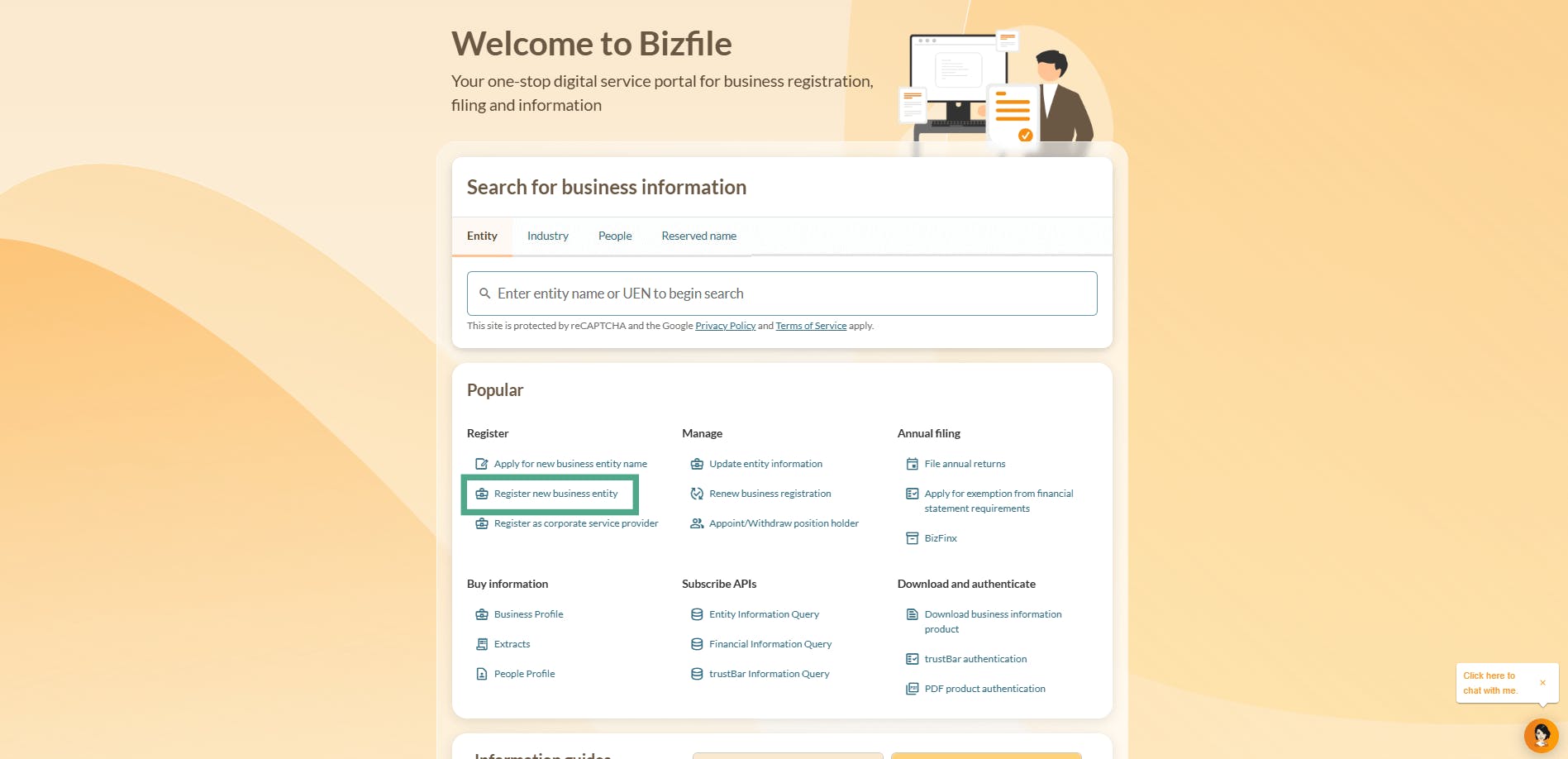
Visit Bizfile via https://www.bizfile.gov.sg, then click on “Register new business entity,” which can be found under “Register.”
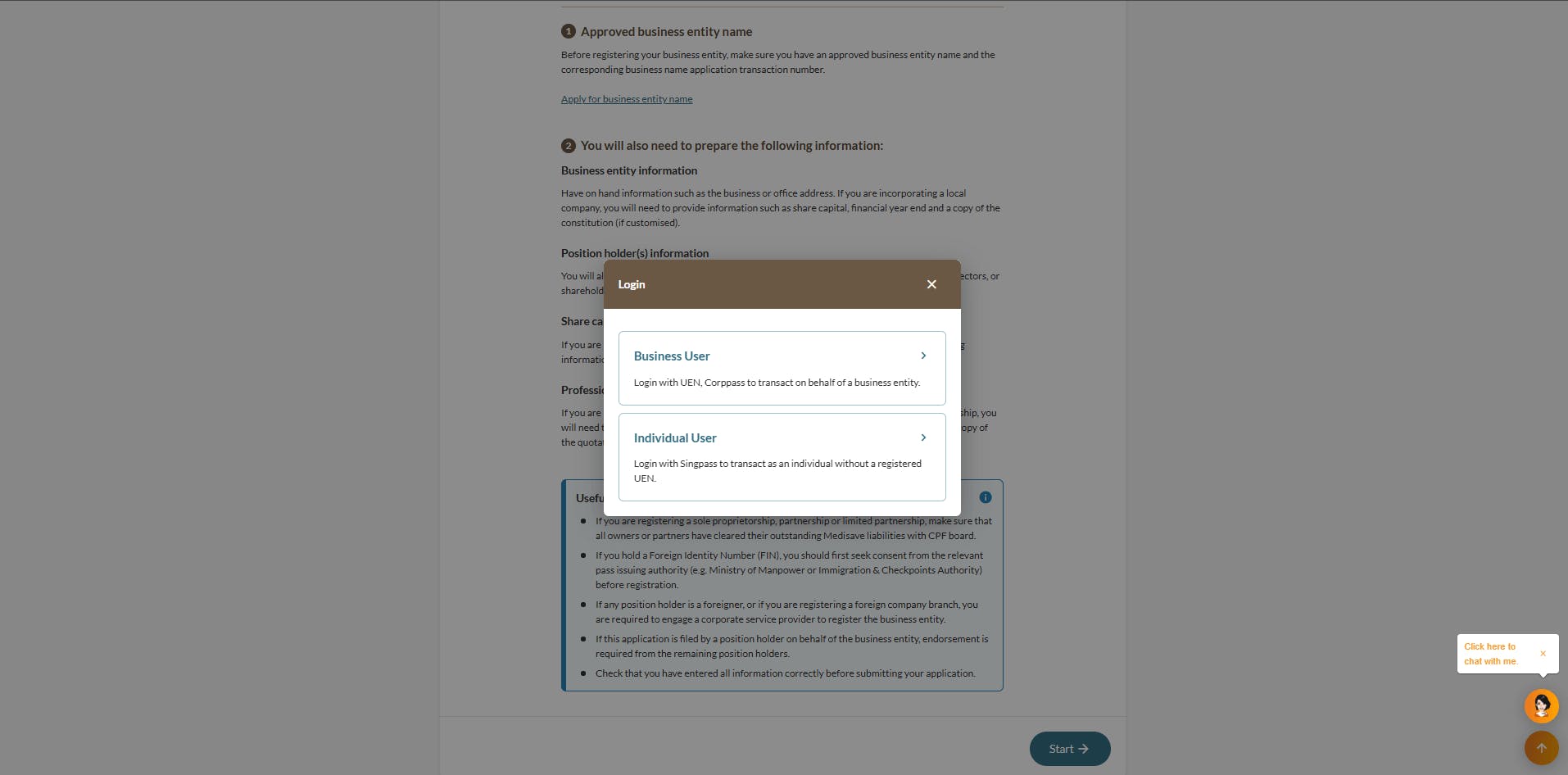
Once you click “Start,” you will be asked if you will log in as a business or individual user. Generally, you should log in as an individual, since the business user option is generally meant for corporate service providers or entities managing filings on behalf of other businesses.
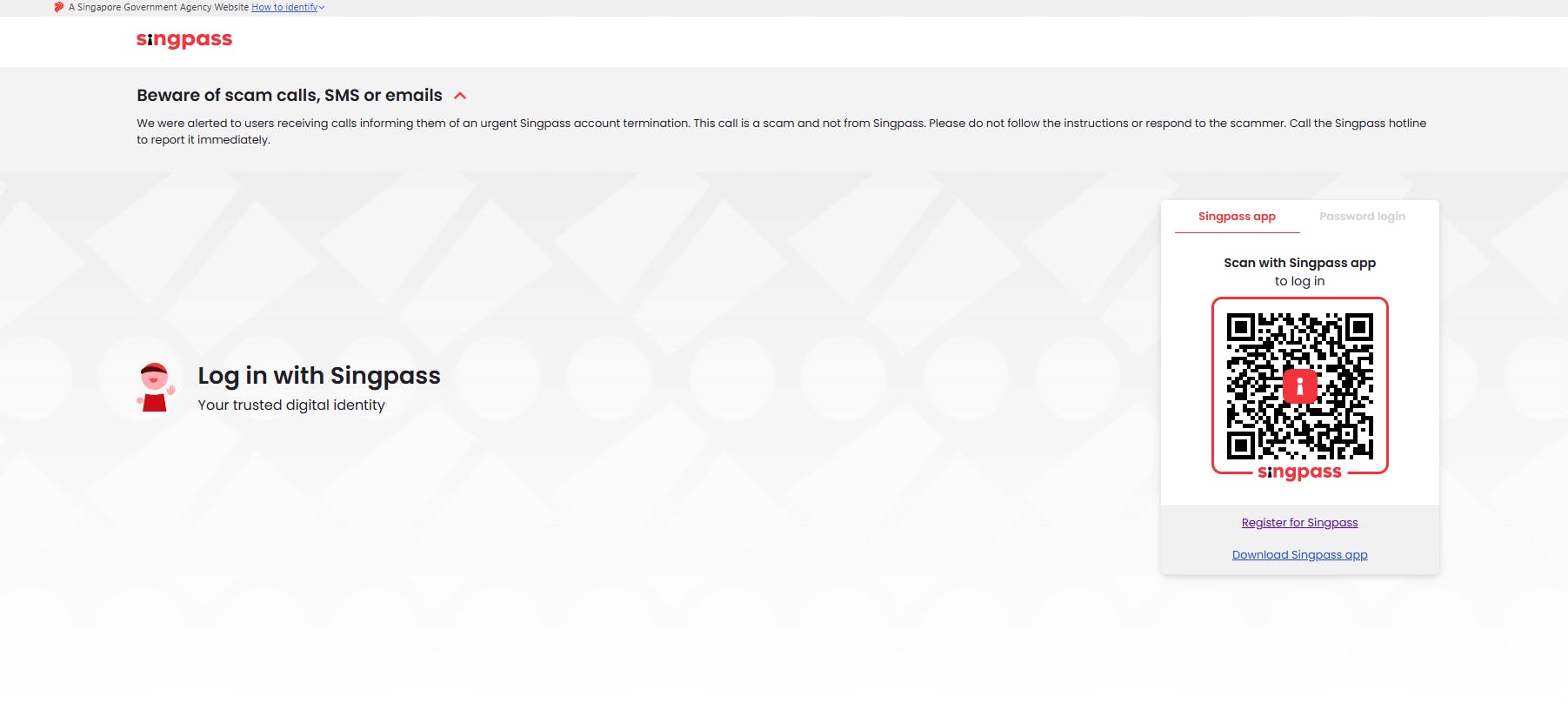
If you are an individual user, you will be redirected to log in using your Singpass.
Enter the transaction number of the approved business name application, then proceed to the next step.
Fill in the information about your company and upload the required documents, including:
- Financial Year-End (FYE) and Financial Year Period
- Additional officers or shareholders
- Share capital, allotment, and shareholder information
- Registered office address and working hours (at least 5 hours during ordinary business hours or at least 3 hours but less than 5)
- Company Constitution
Pay the company registration fee using a credit or debit card (Visa, Mastercard®, or American Express), PayPal, Apple Pay, or Google Pay.
If You Don’t Have a Singpass
If you do not have a Singpass, you must partner with a third-party filing agent or professional company incorporation service to register the company on your behalf. These professional agents are familiar with Bizfile and Singapore’s business registration requirements, so they can help ensure that your application is complete and compliant.
Most professional services will assist you with the following:
- Name checking and reservation
- Document preparation
- Compliance with local requirements, including appointing a local resident director or nominee director if needed
- Registered address service
Using a company incorporation service isn’t limited to those without a Singpass. If you’re managing a small business, these services can help you stay on track and save time.
Tip: It typically costs about SGD 4,095 to incorporate a company in Singapore using incorporation services that cover most or all essentials.
Documents Upon Successful Application
Once your application is submitted and approved, the appointed officers, including the directors, shareholders, and company secretary, will receive an email requesting their endorsement. All appointed officers must confirm their roles in Bizfile within 60 days of the email date, or the application will be cancelled.
After the business is successfully registered, you will receive the following:
Business Profile
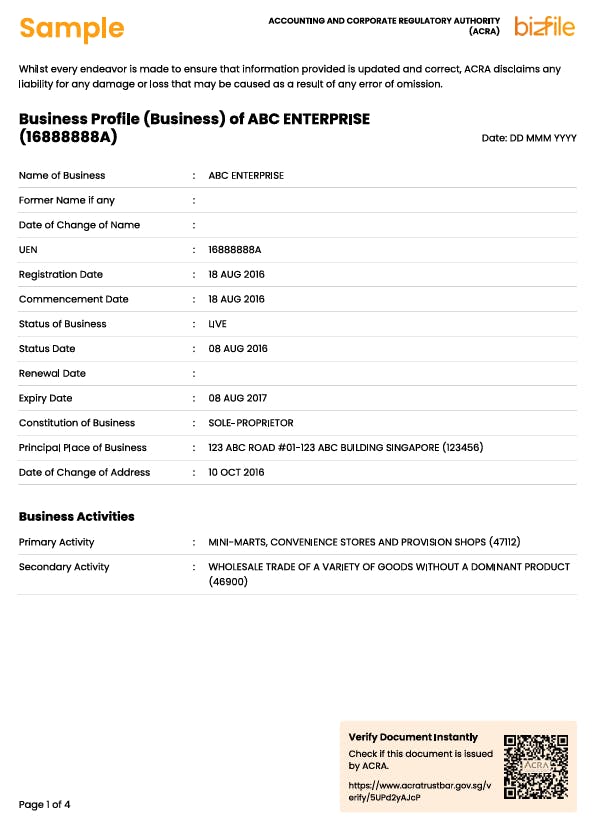
A Business Profile is like an identity card for your Singapore business. It contains details such as the company name, Unique Entity Number (UEN), and business activities. UEN number must always be quoted in business letters, statements of account, invoices, and other official correspondence, along with the company’s name.
An email with instructions on how to download the free Business Profile will be sent to the email address of the person who filed the registration. This free Business Profile must be downloaded within 30 days; otherwise, it will expire and you may need to purchase a new one for SGD 5.50.
You can view samples of the Business Profile for different types of business on the ACRA website.
Tip: A UEN is issued automatically, but you can buy a preferred number from a reserved list. SGD 3,000 for consecutive identical digits or the number 8, or SGD 1,000 for patterned numbers such as repeating digits or triple endings like 222.
Certificate of Incorporation
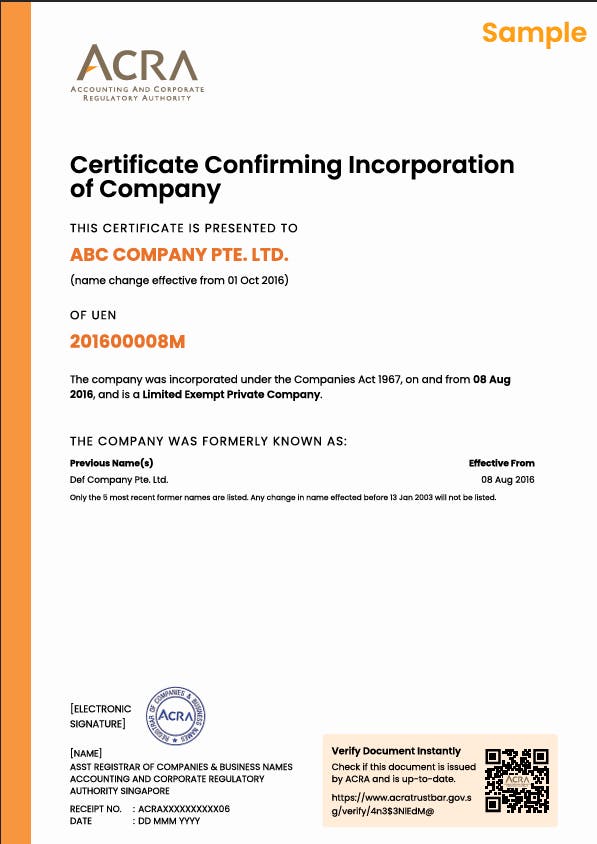
In addition to the Business Profile, you can purchase a Certificate of Incorporation for SGD 50. This document certifies that the company is registered with ACRA in Singapore and may be required when opening a corporate bank account or engaging with government agencies.
You can also purchase other certificates, such as the Certificate of Good Standing, directly from ACRA. It’s important to note that ACRA only provides electronic copies of these documents, not hard copies.

Post-Incorporation Steps
Registering your business is only the beginning. To operate legally and smoothly in Singapore, it’s essential to keep your company information accurate, follow obligations such as annual filing, and consider these additional post-incorporation steps.
Applying for Business Licences
Depending on your activities, your business may need specific licences and permits to operate. Operating without the required approvals can result in penalties, fines, or suspension of business activities.
Common sectors where licences and permits are required include:

Building & Construction

Financial Services

Fundraising & Charity

Dormitory Services

Food & Beverage

Hotel

Education

Healthcare

Travel Agency

Environmental Services

Logistics
After successfully incorporating your Singapore business, you can apply for the necessary licences. The GoBusiness Singapore website offers a complete list of licences you can apply for, along with those for renewal or amendment.
Appointing an Auditor
Private limited companies must appoint an auditor within 3 months of incorporation, as they are required to have their financial statements audited at least once a year, unless they qualify for an exemption as a small company.
To be qualified for the exemption, the company must meet at least 2 of the following over the last two consecutive financial years:
- Have an annual revenue of SGD 10 million or less;
- Have total assets of SGD 10 million or less;
- Have 50 or fewer employees
Once the company qualifies as a small company, it will keep this status in subsequent financial years until it no longer meets the criteria or ceases to be a private company during the financial year.

Annual Filing
All companies, including inactive and dormant ones, must file annual returns, even if exempted by IRAS from filing an income tax return. The annual returns must be filed within 7 months after the end of the company’s financial year. You may apply for an extension of time for the annual return with the ACRA.
Hold An AGM
Under the Singapore Companies Act, companies are required to hold an Annual General Meeting (AGM) within 6 months after the end of its financial year. The AGM is where the company presents its financial statements and updates shareholders on its affairs.
Certain private companies may be exempt from holding an AGM, for example, if financial statements are sent to members within the required timeframe.
You can apply to ACRA for an Extension of Time (EOT) of AGM for up to 60 days. The application must be submitted before the AGM due date.
Register for Corppass
Singapore Corporate Access (Corppass) is an authorisation system for business entities to allow employees and third parties to perform corporate transactions with government agencies online, such as the IRAS (the Inland Revenue Authority of Singapore, which is the government body responsible for taxes) digital services.
After you have registered your company, you can set up and manage your company’s Corppass account on the Corppass website.
Register for Goods and Services Tax (GST)
You must register for GST if:
- Your taxable turnover exceeds SGD 1 million at the end of a calendar year; or
- You expect your taxable turnover to exceed SGD 1 million in the next 12 months.
You can check whether you need to register for GST with the IRAS beforehand.
Once registered, you must:
- Charge 9% GST on taxable goods and services (unless exempt or zero-rated);
- File regular GST returns; and
- Pay the GST collected to IRAS.
To apply for GST registration, you can visit and follow the steps on the IRAS website. The process varies by the type of business.
Business Registration Renewal
Sole proprietorships and partnerships must renew their business registration before the expiry date or up to 60 days prior. Renewal can be done for either 1 year or 3 years at a cost of SGD 30 per year.
Both requirements can be done online through Bizfile.


Opening a Business Account
After registering your company, the next important step is opening a corporate account. A separate account under your company name keeps finances organised and ensures accurate reporting.
When choosing a business account in Singapore, consider the following factors:
- Fees: Check account maintenance fees, transaction costs, and international transfers.
- Setup process: Traditional banks may require in-person visits, while digital banks and fintech providers often allow 100% online setup.
- Currency support: If you deal internationally, multi-currency accounts help reduce conversion costs and simplify receiving payments from international customers or paying overseas suppliers
- Customer Support: Ensure the bank offers personalised and responsive support.
- Integration: Fintech accounts often offer integration with accounting software, streamlining bookkeeping and financial reporting. Many also connect with online marketplaces and payment gateways, enabling faster fund settlement.
Account opening process vary by bank, but major banks in Singapore generally need your Singpass, UEN, and Tax Identification Number. Traditional banks may also require an in person interview.
When you register your Singapore business with Statrys, we assist you in applying for a Statrys multi-currency business account, subject to approval. This account allows you to hold up to 11 major currencies and make international and local transactions at competitive rates, as well as access personalised support from dedicated account managers.


Taxes in Singapore
Lastly, let’s understand how taxes work for your company in Singapore. The Inland Revenue Authority of Singapore (IRAS) oversees corporate taxes and enterprise disbursement schemes.
Corporate Taxes
In Singapore, all companies, both local and foreign, are taxed at a flat rate of 17%. However, similar to Hong Kong, Singapore operates a territorial tax system which means foreign-sources income is generally not liable to tax unless it is remitted into the country. Additionally, Singapore has Avoidance Double Tax Agreements (DTAs) with other jurisdictions to prevent double taxation on income earned in one jurisdiction by a resident of the other.
Your company is responsible for the annual filing of Corporate Income Tax Returns with IRAS. These include:
- Estimated Chargeable Income (EIC): ECI is an estimate of your business’s taxable profits. You will receive the ECI filing notification before the end of your company’s financial year, starting from the year after the incorporation.
- Form C-S/ Form C-S (Lite)/ Form C: These are types of forms for your company to declare its actual income, depending on annual revenue. Typically, all companies are required to file using Form C and submit financial statements and tax computations along with it. New companies will have to file this starting from the second year of incorporation.
Tax Exemption
To encourage business growth, Singapore offers various tax exemption schemes that allow eligible companies to lower their tax burden, especially for start-ups and SMEs. Here’s a look at the key exemptions available:
Start-up Tax Exemption Scheme
New start-ups are allowed a 75% exemption on the first SGD 100,000 of normal chargeable income and a further 50% exemption on the next SGD 100,000 for their first 3 years of operations.
To qualify for this exemption, the company must:
- be incorporated & tax resident in Singapore
- have ≤ 20 shareholders, with at least one individual holding ≥10% of shares
- not primarily an investment holding or property development company
Partial Tax Exemption Scheme
All companies are eligible for partial tax exemption (PTE), which gives a 75% exemption on the first SGD 10,000 of normal chargeable income and a further 50% exemption on the next SGD 190,000.
Tip: In Budget 2026, a 40% CIT Rebate will be granted to all taxpaying companies, regardless of tax residency, for YA 2026 to ease cost pressures.

Singapore Company Registration Service
Statrys is your hassle-free partner for registering a Singapore company, whether you're a foreign entrepreneur, new business owner, or just looking to save time on administration.
Statrys all-inclusive registration package covers everything from incorporation filing and company secretary services to a registered address with mail forwarding.
A fast-track application for multi-currency business accounts is available for efficient payments, along with pay-as-you-go accounting services on the platform. This integrated platform simplifies accounting, business accounts, and company incorporation into a unified digital ecosystem, offering founders full visibility and reduced operational friction.
Incorporation Services
- Registration filing with the Accounting and Corporate Regulatory Authority (ACRA)
- Certificate of Incorporation
- Business Profile
- Company Chop
- Constitution of the Company
- Preparation of pre-incorporation documents
- Preparation of post-incorporation documents
Local Director
- Appointment of a Local Nominee Director (1 year, annual renewal)

Corporate Secretary Services
- Provision of company secretarial services (1 year)
- Annual Return Filing with ACRA for each calendar year
- Holding the Annual General Meeting (AGM) within 6 months after each Financial Year End (FYE) and filing the Annual Return 1 month after the AGM
- Preparation of AGM documents
- Maintenance of the statutory records
- All of your statutory records and compliance documents all in one place, accessible online 24/7

Registered Address in Singapore
- Registered address for one year (annual renewal)
- Scanning and forwarding of mail
Assistance with Opening A Business account
- Assistance with a multi-currency business account opening (Subject to approval)
- Documents for business account setup
Pay-Per-Use Accounting Services
- Bookkeeping: Daily transactions, accounts payable/receivable, bank reconciliation, and payroll management.
- Tax Filing & Compliance: Tax returns, corporate tax planning, and audit support.
- Financial Management: Financial statements preparation, tax planning and advisory.

Sources
Here are links to the official government sources referenced in our guide, where you can find additional information.
- https://www.acra.gov.sg/how-to-guides/setting-up-a-local-company
- https://www.acra.gov.sg/how-to-guides/company-related-fees
- https://www.bizfile.gov.sg/ngbbizfileinternet/faces/oracle/webcenter/portalapp/pages/eServicesListing.jspx
- https://www.gobusiness.gov.sg/licences/
- https://www.iras.gov.sg/taxes/corporate-income-tax/form-c-s-form-c-s-(lite)-form-c-filing/overview-of-form-c-s-form-c-s-(lite)-form-c
- https://www.iras.gov.sg/taxes/corporate-income-tax/income-deductions-for-companies/companies-receiving-foreign-income
- https://www.mof.gov.sg/policies/taxes/corporate-income-tax

The wait is over!
Open your Business Account today!

100% online application
No account opening fee, no initial deposit
Dedicated ccount manager