Written by Bertrand Theaud, Founder of Statrys Over 20 years of experience across Asia as a lawyer, investor, and entrepreneur. I founded Statrys in 2020 after encountering first-hand the banking barriers that SMEs face in Hong Kong, and has since built it into a licensed payment institution trusted by 10,000+ businesses across Hong Kong and Singapore. Last reviewed March 2026. |
Key Takeaways
No single jurisdiction is best for everyone. The right choice depends on your business type, primary payment corridors, and remote access requirements.
Hong Kong and Singapore are the strongest options for cross-border traders managing Asia-Europe or Asia-US payment flows, and both allow fully remote account opening through digital-first providers.
Switzerland, Cayman Islands, and Mauritius serve specific structures (private wealth, investment funds, Africa-Asia holding) and are not suited to general SME operations.
The question is not whether you should bank offshore. If you run a cross-border business and you’re here, you’ve already answered that. The real question is which jurisdiction won’t slow down your actual operations. The wrong choice means minimum deposits that sit idle, FX costs that eat into margin, and payment rails that work on paper but consistently delay your supplier transfers by days.
This guide covers eight jurisdictions: Hong Kong, Singapore, UAE, Switzerland, Cayman Islands, Mauritius, Belize, and Panama. For each, the focus is on the business type it actually fits, not just the headline benefits. The comparison table below gives you a working answer in under a minute; the detailed sections explain the tradeoffs that don’t fit in a table.
The patterns this guide is based on are drawn from working with cross-border businesses across Asia every day, specifically the jurisdictions where accounts open without friction, FX costs are genuinely transparent, and payment relationships hold up to scrutiny from serious counterparties.
Quick Comparison: Which Jurisdiction Fits Your Business
Use this table to orient yourself before reading the detailed sections. ‘Remote opening’ means a fully digital process with no required in-person branch visit.
| Country | Best for | Remote opening |
|---|---|---|
| Hong Kong | Cross-border trade; China, SE Asia payment corridors | Yes, fully remote via digital providers |
| Singapore | Digital services, ASEAN operations, USD/EUR invoicing | Yes, fully remote via digital providers |
| UAE | Gulf, Africa, South Asia operations; free zone companies | Partial: Electronic Money Institutions (EMIs) allow remote onboarding; traditional banks require a branch visit |
| Switzerland | Private wealth, fund structures, HNW asset holding | Limited: most require in-person onboarding |
| Cayman Islands | Investment fund structures, SPVs | Partial: specialist banks vary |
| Mauritius | Africa-Asia holding structures; DTA access | Partial: varies by bank |
| Belize | Low-cost individual access; personal diversification | Yes, several providers fully remote |
| Panama | USD-denominated Latin America operations | Partial: most traditional banks require a branch visit |
Fees and opening terms verified March 2026. Conditions change; confirm with each provider before applying.
What ‘Offshore Banking’ Actually Means in 2026
"Offshore banking" means holding an account in a jurisdiction outside your country of residence or incorporation. For more on what offshore banking means for businesses, including how it differs from international banking and personal savings accounts, see the full explainer. For most entrepreneurs reading this, it means you run a company in one country and need an account somewhere else: for currency diversification, access to better payment infrastructure, or to hold funds where your operations actually run.
What it doesn’t mean: tax avoidance, hidden accounts, or anything that requires a lawyer to explain in whispers. Over 100 countries participate in the Common Reporting Standard (CRS), meaning your home tax authority automatically receives information about your offshore accounts. The US has separate requirements through FATCA and FBAR. Offshore banking is transparent by design in 2026.
The distinction that matters more than the label is this: are you looking for a business transaction account (day-to-day payments, supplier transfers, FX) or a wealth preservation structure (holding assets, protecting capital)? The right jurisdiction for each is different, and most of the confusion in ‘best offshore countries’ lists comes from conflating them. This guide focuses on transaction accounts for SMEs and entrepreneurs.
1. Hong Kong
Hong Kong is the strongest jurisdiction for cross-border businesses with Asia-Pacific payment corridors. Paying suppliers in mainland China, sourcing from Southeast Asia, collecting from buyers in Europe and the US: a Hong Kong-based account gives you direct CNH access, deep USD clearing infrastructure, and no foreign exchange controls.
Traditional banks (HSBC HK, Standard Chartered HK, DBS HK) remain an option but they set high bars. A practical breakdown of the full opening a business bank account in Hong Kong process, including required documents and typical approval timelines, covers this in detail. Standard Chartered requires a six-month average balance of HKD 200,000 (approximately USD 25,000) to waive its monthly maintenance fee. HSBC requires an initial deposit of HKD 10,000 and in-person onboarding, with approval timelines that can stretch to several weeks. DBS waives its monthly fee if the average total deposit balance over the month is at least HKD 50,000.
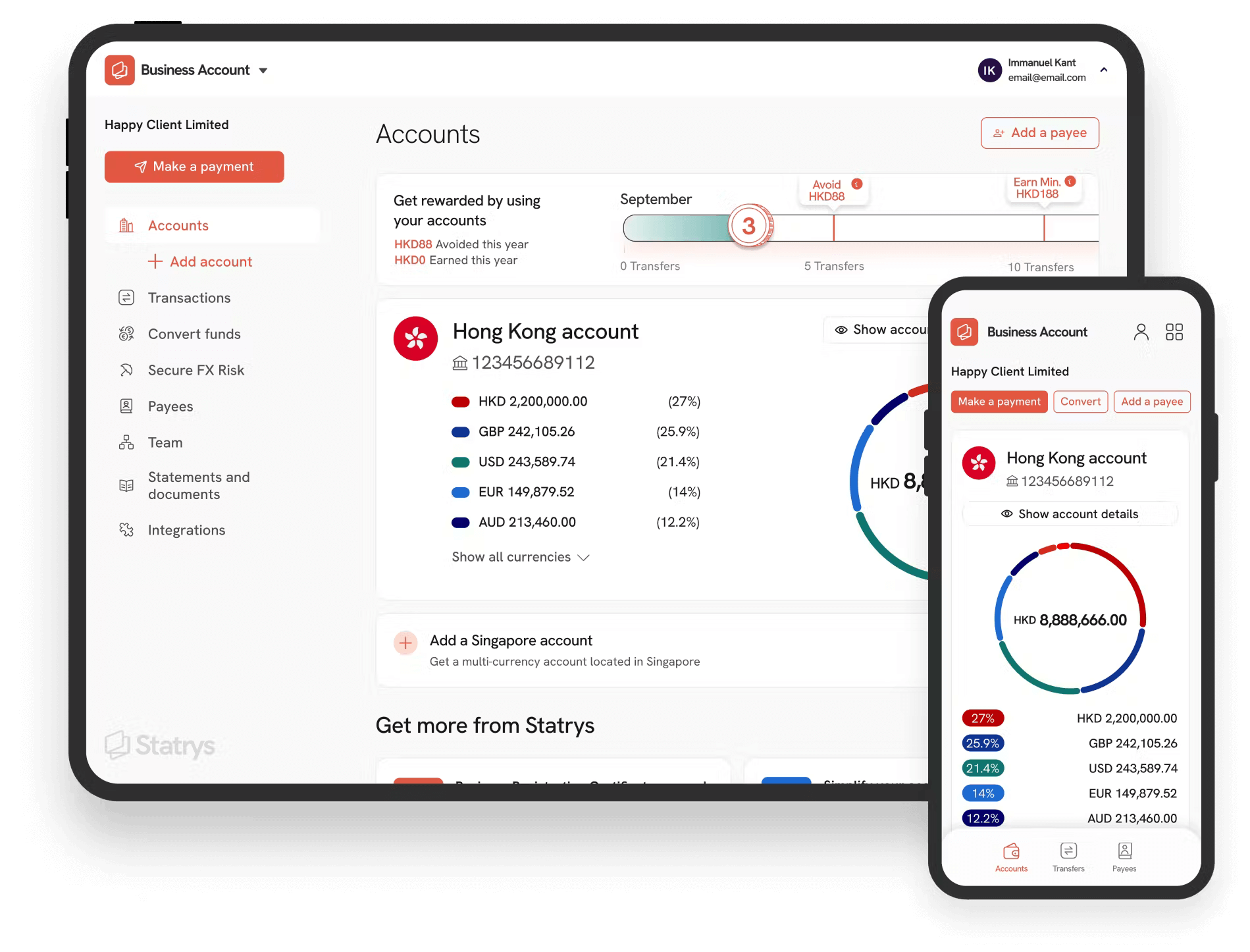
For most cross-border SMEs, digital-first providers give a faster and more cost-effective route. Statrys, licensed by the Hong Kong Customs and Excise Department as a Money Service Operator (MSO), opens accounts fully remotely, with 96% of clients operational within 3 business days. The account supports HKD, USD, EUR, GBP, CNH, and other currencies, with FX fees from 0.1%.
The guide on benefits and risks of offshore banking covers MSO vs. licensed bank distinctions in detail. Over 10,000 businesses use Statrys accounts for cross-border operations.
Deposit protection: Licensed bank accounts in Hong Kong are covered by the Hong Kong Deposit Protection Board (HKDPB) up to HKD 500,000 per depositor.
MSO accounts are not bank deposits and do not carry this protection. For most cross-border operating accounts, this distinction is practical rather than material, but worth knowing.
WHO THIS SUITS
- Cross-border trading companies with China, Southeast Asia, or South Asia payment flows
- Hong Kong-incorporated companies of any size
- Founders setting up a new HK company who need both incorporation and a working account quickly
WHO THIS DOESN’T SUIT
- Businesses with no Asia connection that primarily operate in EUR or GBP
- Companies that need the full deposit protection of a licensed bank

2. Singapore
Singapore is the best fit for digital services companies invoicing in USD or EUR with clients across ASEAN. The MAS (Monetary Authority of Singapore) regulatory framework is mature, English is the primary language of banking, and the digital bank ecosystem is now one of the most developed in Asia.
Traditional banks (DBS, OCBC, UOB) have lower onboarding friction than their HK counterparts for Singapore-incorporated companies owned entirely by Singapore Citizens or PRs — though companies with any foreign director or shareholder may still require a branch visit.
Digital banks in Singapore
The digital banks licensed in Singapore landscape is worth understanding before you apply:
| Bank | Key facts for SMEs |
|---|---|
| ANEXT Bank | Ant Group subsidiary, MAS wholesale digital bank licence. No setup fee, no monthly fee, no minimum balance. Supports SGD, USD, EUR, CNH. Strong for cross-border businesses needing CNH access through Singapore. |
| MariBank | Requires all directors and shareholders with 25%+ shareholding to be Singapore citizens or permanent residents. Foreign-founded companies are generally ineligible. Check your ownership structure before applying. |
| GXS Bank | Backed by Grab and Singtel, GXS Bank operates under a MAS digital bank licence. Applicants must have a residential address in Singapore and be either a Singapore citizen or permanent resident. The account features daily interest with no fall-below fees, no minimum balance requirement, and no annual fees. |

3. UAE
The UAE is the natural home for businesses operating across the Gulf, Africa, and South Asia. Free zone structures (DMCC, JAFZA, RAKEZ, DIFC) give non-residents a legal vehicle for opening a UAE account without local residency. For a detailed breakdown of the offshore bank account in Dubai process, including free zone structures and traditional bank requirements, see the full guide.
Remote opening in the UAE is improving but incomplete. Traditional banks (Emirates NBD, Mashreq, RAKBank) still require at least one authorised signatory to visit a branch for new business accounts. Approval for non-resident applications typically takes two to six weeks. Free zone companies have the fastest path through this process.
International Electronic Money Institutions (EMIs) licensed in the UAE offer remote onboarding within 5–15 business days, but provide more limited local banking functionality than a full business account with a traditional bank.
If UAE banking is important for your business and you won’t be visiting Dubai soon, budget for a trip to combine branch onboarding with other operational needs. Treating it as a necessary investment rather than a friction point makes the timeline easier to manage.
WHO THIS SUITS
- Businesses with primary operations or clients in Saudi Arabia, the Gulf, Pakistan, India, or Africa
- Free zone companies (DMCC, JAFZA, RAKEZ) needing a local banking relationship
- Founders who will visit Dubai and can combine a branch visit with the trip
WHO THIS DOESN’T SUIT
- Founders who need a fully remote process with zero travel
- Businesses without a UAE trade licence (most banks require one for business account opening)
4. Switzerland

Switzerland remains the benchmark for private wealth management. The Swiss franc is one of the most stable currencies globally, Swiss banks offer multi-currency deposits, and the regulatory framework is rigorous. For high-net-worth individuals protecting capital or holding assets, it remains the gold standard.
For most SMEs, it’s the wrong answer. Swiss private banks typically require minimum deposits of USD 250,000–1,000,000.
Dukascopy Bank is a notable exception: a Swiss-regulated online bank with lower entry requirements accessible to non-residents. It’s primarily used for trading and FX rather than operational business accounts, but it gives access to a CHF/EUR/USD account under Swiss banking regulation at a more accessible entry point.
The compliance overhead is significant regardless of provider. Swiss banks conduct thorough KYC and due diligence on business clients, and approval processes for new accounts can take one to three months.
WHO THIS SUITS
- HNW individuals holding significant liquid assets requiring a stable jurisdiction
- Investment fund managers seeking a prestigious, regulated custodian
- Founders with established Swiss business relationships
WHO THIS DOESN’T SUIT
- Most SMEs, where minimum deposits are prohibitive for operational accounts
- Businesses that need fast account opening or low-cost FX on day-to-day transactions
5. Cayman Islands
Cayman Islands accounts are relevant for one specific use case: investment fund structures. The Cayman Islands is the world’s leading domicile for hedge funds, private equity, and venture capital vehicles. If you’re structuring a fund, a Cayman account is likely part of your legal setup as a matter of course.
For operational business banking, it’s a poor fit. The infrastructure is built around fund administration, not day-to-day transactions. Accounts are expensive to open and maintain.
Remote onboarding exists at some institutions but is subject to heightened due diligence and is typically geared toward fund structures.
WHO THIS SUITS
- Investment fund managers and sponsors requiring a Cayman fund structure
- SPV (Special Purpose Vehicle) structures for specific transactions
- Legal structures where a Cayman entity is required by fund documents or LPA
WHO THIS DOESN’T SUIT
- SMEs that need operational accounts for day-to-day payments
- Anyone looking for a simple, low-cost cross-border account
6. Mauritius

Mauritius has one specific advantage the other jurisdictions in this guide don’t match: its Double Tax Agreement (DTA) network. Mauritius has signed DTAs with India, China, and several African countries, making it useful for holding structures that route investment or royalties between these markets.
A Mauritius-incorporated company can hold a local bank account and benefit from reduced withholding tax rates when receiving income from certain DTA partners. For Africa-focused businesses, Mauritius is the most credible offshore jurisdiction in the region.
Mauritius Commercial Bank (MCB) and AfrAsia Bank, for example, also provide banking services for foreign-incorporated companies.
WHO THIS SUITS
- Holding companies routing Africa-Asia investment income or IP royalties
- Businesses with Indian or African operations seeking reduced withholding tax under DTA
- Fund structures targeting African markets
WHO THIS DOESN’T SUIT
- Cross-border traders needing fast, low-cost payments (Hong Kong or Singapore are materially better)
- Businesses with no Africa or India angle (the DTA network is the reason to be here)
7. Belize
Belize is the most accessible offshore jurisdiction on this list. Several Belize-licensed banks and financial institutions allow account opening for non-residents with relatively low minimum balances. Entry points starting around USD 2,000 are available at some institutions.
The trade-off is credibility. Belize accounts are not taken seriously by major correspondent banks, large clients, or institutional counterparties. If you need an account that your supplier will comfortably wire significant funds into, Belize is a risk. For personal wealth diversification or low-volume holdings where correspondent bank standing is not critical, the accessibility is the point.
WHO THIS SUITS
- Individuals seeking a low-cost, remote-open account for personal asset diversification
- Small businesses with simple, low-volume transactions where correspondent credibility is not a concern
WHO THIS DOESN’T SUIT
- Any business that needs to receive large transfers from major clients or financial institutions
- SMEs with complex compliance requirements or regulated counterparties
8. Panama
Panama’s dollarised economy and its position as the financial centre of Latin America make it the natural choice for businesses with USD-denominated transactions across the region. Panama City is home to major regional banks (Banistmo, Banco General, BAC Credomatic) with deep USD infrastructure and strong correspondent relationships throughout Latin America.
Panama was removed from the FATF (Financial Action Task Force) grey list in October 2023, following significant regulatory reforms. The compliance environment has tightened as a result: banks now conduct more extensive due diligence on new account holders, and approval timelines for non-residents have extended.
Remote opening varies by institution. Most traditional Panamanian banks require in-person visits for non-resident business accounts. Some fintech-adjacent options allow partial remote onboarding, but typically require in-person verification at some stage.
WHO THIS SUITS
- Businesses with primary operations in Latin America and USD-based transactions
- Companies that can accommodate an in-person visit to Panama City
- Founders who need access to the Latin American correspondent banking network
WHO THIS DOESN’T SUIT
- Businesses needing CNH, EUR, or SGD as primary currencies
- Founders who need fully remote opening with no travel
How to Choose: Four Decision Factors
Making a decision on which jurisdiction to choose is not easy, but here are four questions to help you narrow the list down.
1. Where are your payment corridors?
The right jurisdiction is the one closest to your actual money flows. For a direct comparison of Hong Kong vs Singapore as operating bases, covering tax, incorporation, banking, and FX, see the full breakdown. In brief: paying suppliers in China and collecting in USD/EUR means Hong Kong. Invoicing in USD to ASEAN clients means Singapore. Moving money to or from the Gulf, India, or Africa means UAE or Mauritius. Latin America in USD means Panama.
2. What is your tolerance for reputation risk?
Some clients and suppliers ask where your account is. HSBC and DBS open doors. A Belize bank number closes some. If your counterparties are major corporates or financial institutions, the jurisdiction’s standing matters more than the account opening fee.
3. What is the total cost, not just the headline fee?
The account opening fee is the smallest number in the comparison. What matters: monthly maintenance fees and the balance required to waive them, FX spread on every transaction, and minimum deposits that sit idle. A provider with FX fees from 0.1% on USD 500,000 in annual payment volume saves you roughly USD 4,000–6,000 per year compared to a bank charging 0.9–1.2% FX spread. The account opening cost is a one-time number; the FX cost is recurring.
4. Can you actually open it remotely?
‘Available to non-residents’ and ‘fully remote end-to-end’ are different things. UAE traditional banks say yes to the first and no to the second. Hong Kong and Singapore digital providers answer yes to both. If you won’t be visiting the jurisdiction soon, remote opening is a hard constraint, not a preference.
Is Offshore Banking Legal?
Yes. Holding a bank account outside your home country is legal in virtually every jurisdiction. The legal obligation is reporting, not restriction.
Common Reporting Standard (CRS)
Over 100 countries participate in automatic information exchange under CRS. If you hold a bank account in Singapore and you’re a UK tax resident, HMRC will receive information about that account automatically each year. The same applies to most major offshore jurisdictions. Offshore banking is transparent by design.
US requirements (FBAR and FATCA)
US persons (citizens and green card holders) must file an FBAR (FinCEN Form 114) if the aggregate value of all foreign financial accounts exceeded USD 10,000 at any point during the calendar year. FATCA (Form 8938) has separate thresholds: USD 50,000 at year-end or USD 75,000 at any point during the year for US residents; higher thresholds apply if you live abroad. Both are reporting requirements, not restrictions on holding foreign accounts.
UK requirements
UK residents report foreign income on SA106 as part of their annual Self Assessment tax return.
The compliance is administrative, not prohibitive. If your business is legitimate and your accounts are reported correctly, offshore banking is straightforward. The jurisdictions in this guide all participate in CRS or have bilateral information exchange agreements, and there is no meaningful secrecy.
Opening a Business Account in Hong Kong or Singapore
If Hong Kong or Singapore is the right jurisdiction for your operations (it is for most cross-border SMEs), Statrys opens multi-currency business accounts fully remotely. No branch visit. No minimum balance. 96% of clients are operational within 3 business days.
The account supports 11 currencies including HKD, USD, EUR, GBP, CNH, SGD, and JPY. If you’re deciding between a dedicated multi-currency structure and a standard business account, the guide on what a multi-currency account is covers the practical differences. FX fees start from 0.1% based on real-time mid-market rates. Over 10,000 businesses have opened accounts through Statrys, with $7B+ in transfers processed.
For Hong Kong-incorporated companies, accounts can be opened simultaneously with company incorporation, so you’re operational from day one rather than waiting weeks for a traditional bank to approve your application.
Was this article helpful?
Yes
No
FAQs
Which country is best for offshore banking for a small business?
For most SMEs, Hong Kong or Singapore. Both offer fully remote account opening, deep multi-currency infrastructure, and strong reputations with international counterparties. Hong Kong is the stronger choice for businesses with China and Asia-Pacific payment flows; Singapore fits digital services companies invoicing in USD or EUR. UAE, Mauritius, and Switzerland serve specific use cases (Middle East/Africa operations, holding structures, private wealth) and are not general-purpose choices for a standard operating business account.