Key Takeaways
EU residents can open a bank account with standard documents. Non-residents and US citizens face additional checks, but regulated online providers offer a faster, fully digital alternative.
The core documents are a valid passport or government-issued ID, proof of address, and proof of residency status if you are not an EU citizen. Business accounts require additional company documents.
Traditional banks require a branch visit for non-residents. Fintechs handle everything online and accept applicants from most countries.
A European bank account — or a payment account with a European IBAN — lets you send and receive euros across 41 SEPA countries like a local. You can pay suppliers, collect client payments, and settle invoices across SEPA countries without the friction of currency conversion or cross-border bank codes.
But getting approved is not always instant. If you are based in the EU, opening an account is often straightforward. If you are a non-resident business owner or a US citizen, expect more checks and more preparation.
In this guide, you will learn who is eligible, what documents you need, how to apply, and which providers are worth considering in 2026. You will also find specific guidance for non-residents, a note on FATCA for US citizens, and a checklist of common friction points to review before you apply.
Can non-residents open a European bank account?
Yes. Non-residents can open a European bank account, but approval depends on the European country you are applying in and the bank's own policy.
Most banks assess how strong your connection is to the country where you are applying, so your chances of approval are generally higher if you can demonstrate the following:
- A clear reason for the account, such as relocation, work or study, property ownership, or a business connection
- A practical local use for the account, such as receiving euro payments or paying rent and bills
Make sure your documents are complete, clearly legible, and consistent with the details in your application. If they are not in English or the local language, get them translated before you apply.
Requirements by Country and Applicant Type

Who Is Eligible to Open a European Bank Account?
To open a bank account in Europe, you generally need to be a legal resident of an EU or EEA country and at least 18 years old. The specific requirements also depend on the bank and the country you are applying in.
If you are an EU or EEA resident, you have a legal right to a basic payment account in your country of residence under EU Directive 2014/92/EU (the Payment Accounts Directive). This right applies even if you are not in permanent employment. Note that this right may cover basic payment accounts, not all account types.
If you are a non-resident, some European banks may still accept your application, but approval depends on the country and the bank’s policy.
What Documents Do You Need to Open a Bank Account in Europe?
The exact requirements depend on your bank, the country you are applying in, and whether you are opening a personal or business account.
Here is what to prepare for each.
Documents for a Personal Account
You will usually be asked for the following:
- Proof of identity: Government-issued ID, such as a valid passport or driving licence.
- Proof of address: Proof of your mailing address in Europe, such as a utility bill, bank statement, or tenancy agreement showing a European address, usually dated within the last three months.
- Proof of residency status: If you are not an EU citizen, you may also need a valid residence permit or visa.
Additional documents you may be asked for
|
Documents for a Business Account
The requirements start the same as a personal account, with extra documentation for your business:
- Certificate of incorporation or business registration
- Proof of registered business address
- Details of directors, shareholders, and beneficial owners (typically anyone holding more than 25%)
- Business bank statements or proof of trading activity
- Description of business activities and expected transaction volumes
- Additional source of funds documentation, particularly for non-resident companies
Steps to Open a Bank Account in Europe
The process of opening a bank account in the EU varies by provider, but these steps apply to most situations.
Before you start, check that you meet your provider's eligibility requirements, as these often differ for residents, non-residents, and US citizens.
Step 1: Choose a Bank or Payment Provider
Compare providers on the following:
- Eligibility: Check that the provider accepts your residency status and supports business accounts if that is what you need.
- Account type: A bank account comes with DGS deposit protection up to €100,000 per depositor per bank. A payment account is covered by safeguarding rules, meaning your funds are held separately from the provider's own money but are not insured under the DGS. For everyday payments, both work. For holding larger business balances, a licensed bank with DGS coverage is the safer choice.
- Local vs foreign IBAN: If you need to pay suppliers, receive local payroll, or set up direct debits, check whether the provider issues an IBAN in your country of residence. Some fintechs issue IBANs from a different country, which can cause problems with local payments.
- Fees: Look beyond the headline monthly fee. Check incoming SWIFT transfer fees, ATM withdrawal costs, card delivery charges, inactivity fees, and FX markup on card spending.
Step 2: Prepare the Required Documents
Gather everything before you start your application.
- For online applications, prepare clear digital scans (minimum 300 DPI) or high-quality photographs.
- For in-person applications, bring originals. Most banks will not accept photocopies unless they can verify them against the original on the spot.
If you are a non-resident or a US citizen, write a short explanation of why you need a European account. This can prevent unnecessary back-and-forth with the bank's compliance team.
Step 3: Apply Online or in Person
Once you have gathered the required documents, the next step is to complete the application through the method offered by your chosen provider.
Online
Most EU banks and all major neobanks offer full online onboarding for residents. Non-residents and US citizens can also apply fully online through regulated payment institutions.
You will typically complete an application form, upload your documents, and verify your identity via video call, selfie, or SMS OTP. Your IBAN is available immediately upon approval, and a physical card follows within 5 to 10 working days.
In person
Traditional banks may still require an in-branch appointment to complete identity checks or review documents, especially for non-residents or applications that need a manual compliance review.
This also applies to business account applications at most providers. Schedule an appointment in advance and bring all original documents and a written explanation of why you need the account.
Step 4: Activate Your Account
After the bank reviews your application, it will confirm your account details. Traditional bank accounts are typically active within one to five business days. Neobank accounts are often activated immediately.
Physical debit cards usually arrive within five to ten working days. Some providers issue a virtual card straight away for online spending.
How to Avoid Delays When Opening a European Account
Most delays happen when the bank cannot verify your details quickly or when your documents do not meet their requirements. Review this checklist before you apply.
☑️ Get your address proof right
Use proof of address issued within the last three months, in English or the local language. Avoid temporary addresses such as hotels, Airbnb, forwarding services, and virtual offices, as banks often reject them. For business accounts, use your registered office address and make sure it matches your official company documents.
☑️ Confirm your residency status
Know your legal residency and tax residency before you apply. Banks usually check legal residency, and may also ask for tax residency for CRS or FATCA reporting. CRS is the global standard that banks use to report foreign account holders to tax authorities.
☑️ Prepare for source of funds checks
Have a clear explanation of where your money comes from. Banks must verify the source of funds under anti-money laundering rules, especially if you expect large transfers, irregular deposits, or high volumes. Keep supporting documents ready in case the bank asks for them.
Best Euro Account Providers
Finding the right provider depends on your residency status, whether you need a personal or business account, and how you plan to use it. Start with the Account Type column to filter options relevant to your situation, then check eligibility and key features.
| Provider | Account Type | Who Can Apply | Key Features |
|---|---|---|---|
| N26 | Personal | EU/EEA; Not available to US residents | • German IBAN • EUR only |
| Revolut | Personal and Business | EU/EEA, US, UK, and more | • Lithuanian IBAN (EEA accounts) • No EU IBAN for US accounts • 25+ currencies (EUR, USD, GBP, CHF, HKD, SGD) |
| Wise | Personal and Business | EU/EEA, US, UK, and more | • Belgian IBAN for EUR • 40+ currencies (EUR, USD, GBP, CHF, HKD, SGD, AUD) |
| Bunq | Personal and Business | EU/EEA residents only | • NL, DE, FR, ES, or IE IBAN based on location • 22 currencies (EUR, USD, GBP, CHF, AUD, CAD) |
Always confirm current eligibility and account terms directly with each provider before applying.
Final Word
Before you apply, confirm three things: your legal residency status, whether you need a bank account (DGS-protected) or a payment account (safeguarded), and which provider's eligibility requirements match your situation. Getting these right upfront is what separates a smooth application from a weeks-long back-and-forth.

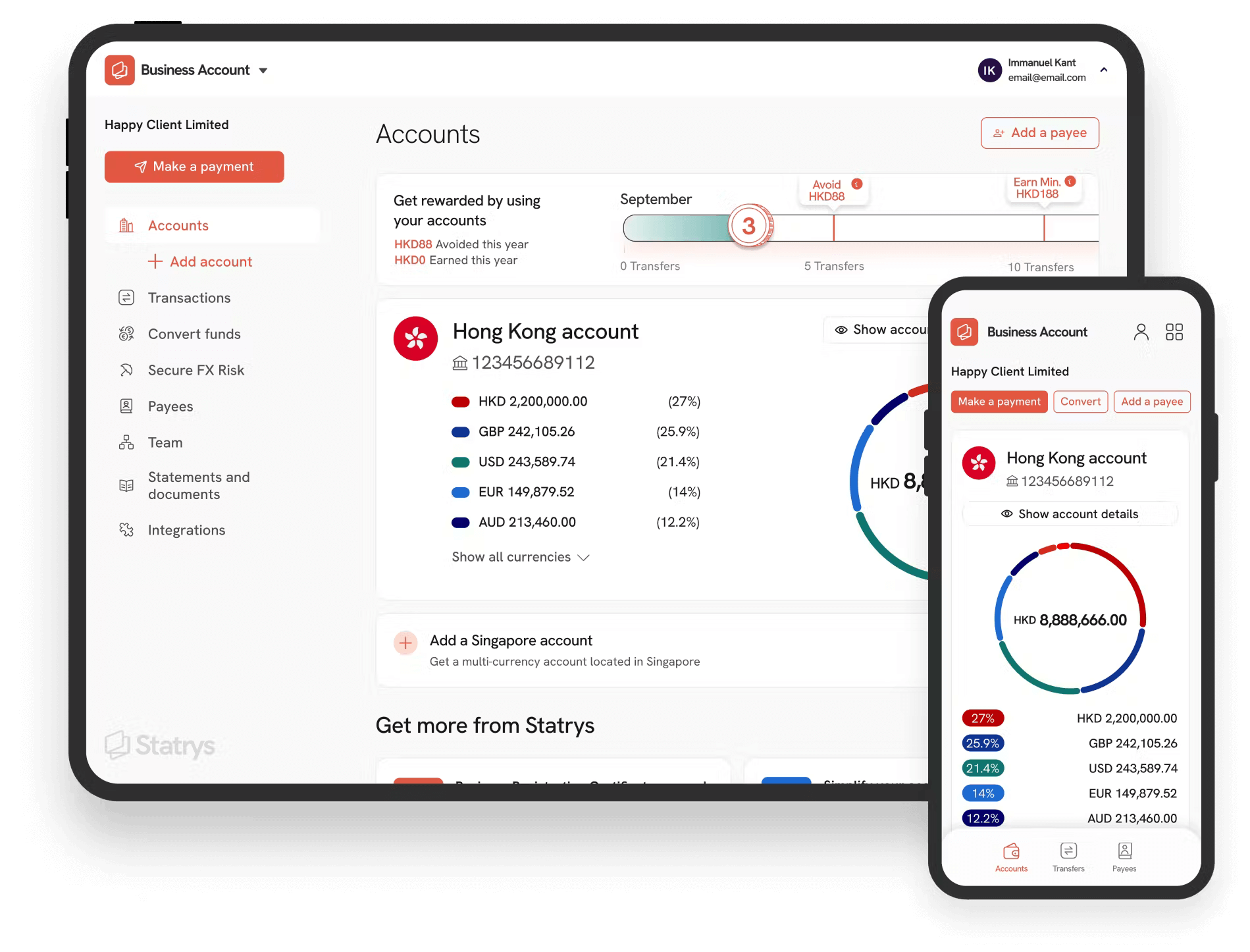
Need to send and receive EUR without a European bank account? Statrys supports EUR and 10 other currencies in one business account, open to companies registered in Hong Kong, Singapore, or the BVI, with FX fees starting from 0.1% and a dedicated account manager.
Was this article helpful?
Yes
No
FAQs
Can a non-resident open a bank account in Europe?
Yes, but approval depends on the country and the bank. Some countries, like Germany and Austria, are strict and often decline non-residents. Others, like France and the Netherlands, accept non-residents with proof of a local connection. Fintechs are the most accessible option as they accept non-residents and allow fully remote sign-up.