Written by Bertrand Théaud, Founder of Statrys Bertrand spent 20 years working across Asia as a corporate lawyer, investor, and entrepreneur before founding Statrys in 2020. Last reviewed March 2026. |
Key Takeaways
Most Hong Kong businesses should maintain at least 3 accounts: an operating account for daily transactions, a multi-currency account for foreign currency receipts, and a separate reserve account for tax and profit.
Spreading your funds across multiple HKDPB-member banks increases your deposit protection — the Hong Kong Deposit Protection Board covers up to HKD 800,000 per depositor per bank.
Virtual banks and licensed payment institutions in Hong Kong (like Statrys) can open accounts in a few days — bypassing the weeks-long process at traditional banks.
There is no legal limit on how many business accounts a Hong Kong company can hold. The right number depends on your transaction volume, currencies handled, and how you want to separate funds.
If you run a company incorporated in Hong Kong — whether you're a cross-border trader paying suppliers in USD and CNY, or a digital services founder receiving EUR from European clients — your business banking setup is not just a convenience. It is part of how you protect your cash, manage foreign exchange risk, and stay on top of your tax obligations.
This guide covers how many bank accounts a Hong Kong business typically needs, what each account should be used for, and how to manage multiple accounts without creating an administrative burden. You will also find a comparison of your provider options — from traditional banks to virtual banks to licensed multi-currency payment platforms.
Research disclosure: This guide draws on our experience supporting 10,000+ SMEs opening business accounts in Hong Kong and Singapore since 2020. Recommendations reflect patterns from real client cases, alongside publicly available information from the HKDPB, HKMA, and major banking providers.
What Is a Business Account?
A business account is a bank account or financial account held in your company's name — not your personal name. It exists to separate your business income and expenses from your personal finances, which is both a legal safeguard and a tax reporting requirement for most Hong Kong companies.
In Hong Kong, the term is often used interchangeably with corporate account or commercial account. For companies with cross-border operations, a multi-currency account — one that can hold and transact in multiple currencies — is a distinct category worth understanding separately.

Why Most Hong Kong Businesses Need More Than One Account
The short answer: visibility and control. A single account that mixes revenue, operating expenses, tax reserves, and payroll is a bookkeeping problem waiting to happen — and it becomes harder to manage as your transaction volume grows.
There are 4 practical reasons to structure your business across multiple accounts:
- Cleaner bookkeeping. When income comes into one account and expenses go out of another, reconciling your accounts at month-end takes minutes, not hours. Your accountant will thank you.
- Better cash-flow visibility. You can see at a glance how much is set aside for tax, what is available for operations, and whether your FX balances need to be converted.
- Operational continuity if an account is frozen. Banks occasionally freeze accounts during compliance reviews or large-transaction disputes — sometimes without warning. A business with one account can be left unable to pay suppliers or staff until the issue is resolved. A second active account eliminates this risk.
- More deposit protection under the HKDPB. The Hong Kong Deposit Protection Board covers deposits up to HKD 800,000 per depositor per bank. Funds spread across two banks can be protected up to HKD 1.6 million in total. More on this below.

Helpful Resource: Understand how to unfreeze a bank account.
The 3 Core Accounts Every Hong Kong Business Should Have
Most Hong Kong-incorporated businesses — whether a trading company, digital agency, or consulting firm — need these three account types from day one.
| Account Type | Purpose | Best For |
|---|---|---|
| Operating / Current Account (HKD) | Day-to-day inflows and outflows — client payments, supplier payments, payroll | All businesses |
| Multi-Currency Account | Receiving and holding USD, EUR, GBP, CNY and other foreign currencies; managing FX conversion timing | Any business with cross-border income or expenses |
| Tax & Profit Reserve Account | Ring-fencing funds for profits tax, salaries tax provisions, and profit distributions | All businesses — especially if tax obligations are significant |
1
Your Operating Account
This is your main HKD transactional account. All your local income comes in here; your local expenses go out from here. Most businesses keep this account at a traditional bank (HSBC, Standard Chartered, Hang Seng, Bank of China) or one of Hong Kong's licensed virtual banks (ZA Bank, livi bank, Fusion Bank).
Opening a business current account at a traditional bank in Hong Kong typically takes 5–7 working days and requires a minimum deposit of HKD 10,000. Virtual banks can open accounts in 3–5 business days with no minimum balance.
2
A Multi-Currency Account
If your business receives payments in USD, EUR, GBP, or any other foreign currency — or pays suppliers in currencies other than HKD — a dedicated multi-currency account is not optional. It is a cost-saving tool.
Without one, every foreign currency payment gets converted to HKD at your bank's exchange rate, which typically includes a spread of 1–3%. With a multi-currency account, you can hold the foreign currency and choose when to convert — capturing better rates and avoiding conversion on every transaction.
3
A Tax and Profit Reserve Account
Hong Kong’s profits tax rate is 8.25% on the first HKD 2 million of assessable profits for corporations, and 16.5% above that. If you are not setting aside funds regularly, your annual tax bill can arrive as a shock.
Keep a separate savings or interest-bearing account into which you transfer a fixed percentage of every income payment. Treat it as an account you do not touch until your accountant instructs you to. Some founders use this account to accumulate both tax provisions and profit distributions — which is fine, as long as you track the split internally.

Relevant: Explore all the varieties of business bank accounts and determine which one suits your needs best.
When to Add a 4th (or More) Account
Three accounts cover most early-stage businesses. You will need a fourth — or more — in these situations:
- You hire employees. Open a dedicated payroll account. This keeps salary payments separate from operating expenses and makes payroll reconciliation straightforward, especially if you use accounting software like Xero.
- You manage multiple projects or revenue streams. If you run a consulting firm where different clients are billed separately, a project-specific account helps you track income and expenses per engagement without a complex accounting setup.
- You want to maximise deposit protection. Adding a second bank account at a different institution effectively doubles your covered deposits under the HKDPB (see next section).
- You need a USD or EUR settlement account. If a significant portion of your business runs in a single foreign currency, a standalone account in that currency (rather than a multi-currency wallet) can simplify large-value transactions.
There is no right number beyond three. Add accounts when they make your financial management easier, not to hit a target.
Traditional Banks vs. Virtual Banks vs. Payment Service Providers in Hong Kong
For most Hong Kong businesses, there are 3 provider types offering business accounts, which are traditional banks, virtual banks and licensed payment service providers. Here’s how they compare.
| Provider Type | Examples | Account Opening | Min. Balance Req. | Multi-Currency | HKDPB |
|---|---|---|---|---|---|
| Traditional bank | HSBC, Standard Chartered, Hang Seng | 5-7 business days | HKD 10,000+ | ✅ | ✅ |
| Virtual bank | ZA Bank, Livi Bank, Fusion Bank, Airstar Bank | 3–5 business days | None typically | Limited — HKD-focused | ✅ |
| Licensed payment service provider | Statrys | 1–3 business days | None | ✅ 11 currencies | ❌ |
Note that the data is accurate as of 20 March 2020 and may have changed since then. Please check with each provider’s website for the most updated information.
Which Provider Type Is Right for Your Account Structure?
For most Hong Kong businesses, the practical answer is to combine 2 types:
- Operating account: Open at a traditional bank or virtual bank for credibility with local clients, payroll, and HKD transactions.
- Multi-currency account: Open with a licensed payment institution or specialist provider for foreign currency receipts and FX management.
This combination gives you local payment credibility (important for suppliers who are wary of non-bank providers), multi-currency flexibility at lower FX costs, and — if you use providers from different HKDPB arrangements — broader deposit protection.
How to Open Multiple Business Bank Accounts in Hong Kong
Opening a second or third business account follows the same process as your first. The documents required vary slightly by provider, but the standard set for Hong Kong companies is:
- Certificate of Incorporation
- Business Registration Certificate
- Memorandum and Articles of Association
- Board of Directors resolution authorising the account opening
- Government-issued ID for all directors and ultimate beneficial owners (UBOs)
- Proof of residential address for all directors (dated within 3 months)
- Certificate of Incumbency (confirms the company's management and ownership structure is in good order)
- Organisational chart showing shareholding and management structure
- Business plan (for some traditional banks — typically a 12-month revenue and expense projection)
Certified true copies of incorporation documents are generally required. These can be certified by a lawyer, notary public, CPA, or company secretary.

For non-resident directors: Traditional banks in Hong Kong often require in-person or video verification for company accounts with foreign directors. Virtual banks and payment institutions typically handle this entirely online. If you are not based in Hong Kong, factor this into your provider choice.
How to Manage Multiple Business Accounts Without Losing Control
Multiple accounts only improve your finances if you manage them deliberately. These 6 practices keep the setup clean:
- Assign a clear purpose to each account before you open it. Write down what each account is for: receiving income, paying expenses, holding tax reserves, and managing foreign currency. An account without a defined purpose becomes a dumping ground.
- Choose providers with no or low inactivity fees. Some accounts charge fees if you do not maintain a minimum balance or a minimum number of transactions. For example, Statrys charges an inactivity fee of HKD 88 per month if fewer than five outgoing payments are made. Understand the fee structure of every account you hold.
- Reconcile all accounts on the same day each month. Many companies in Hong Kong pick the last business day of the month for reconciliation. This prevents small errors from compounding.
- Connect your accounts to accounting software. Xero integrates directly with an account and automatically pulls transaction data. This eliminates manual data entry and reduces reconciliation time.
- Control access deliberately. If anyone other than you has access to an account, document their permissions explicitly. Review access rights quarterly, especially if team composition changes.
- Flag dormant accounts. If an account has had no transactions for 90 days, either close it or document why it is being retained. Dormant accounts accumulate fees and create audit complexity.
Opening a Multi-Currency Business Account with Statrys
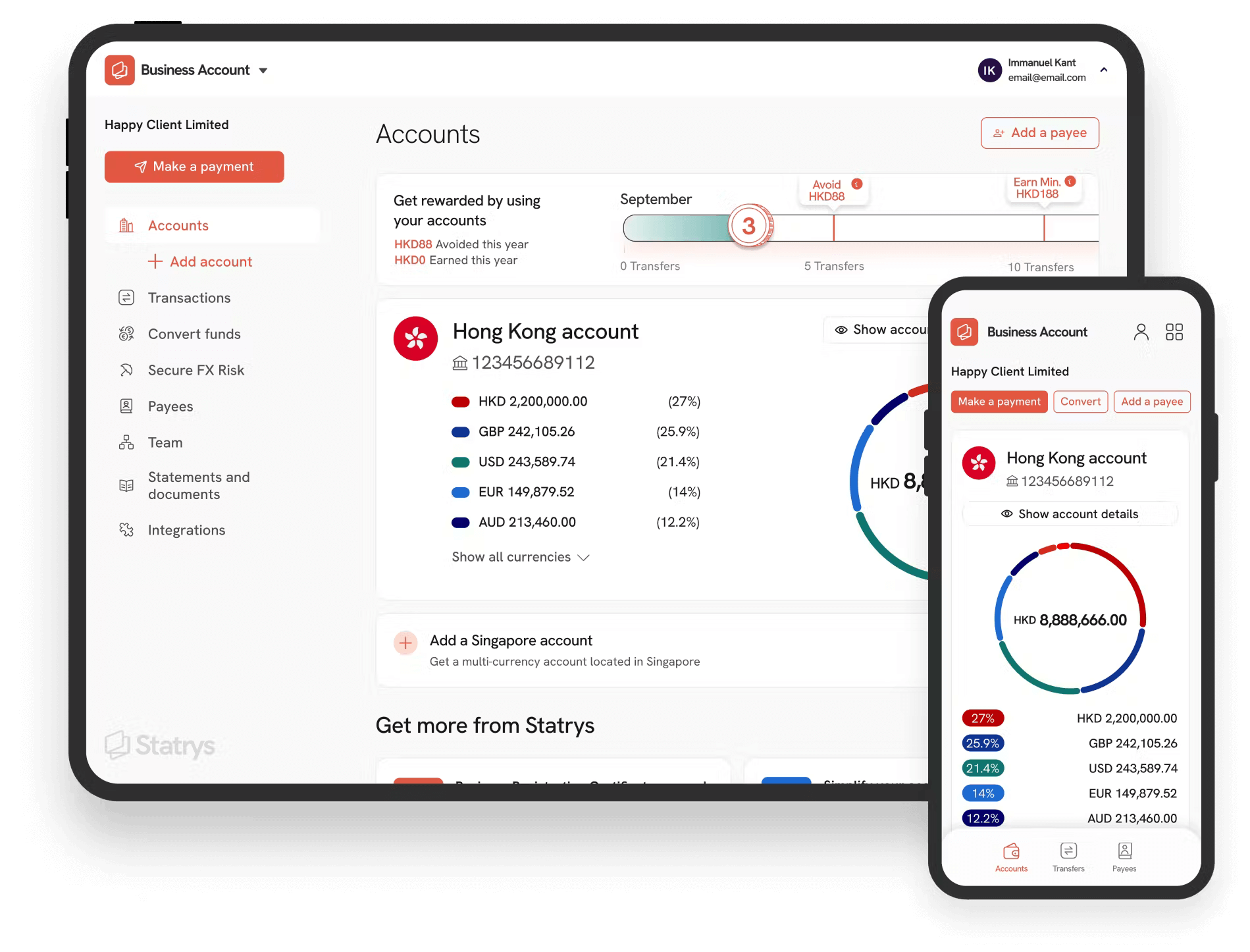
Statrys is not a bank, but a licensed Money Service Operator (No.19-02-02726), offering a multi-currency business account designed for companies registered in Hong Kong, Singapore and the British Virgin Islands (BVI).
Key features of Statrys business account:
- Support 11 major currencies: Send, receive and hold payments in USD, EUR, GBP, CNY, HKD, SGD, AUD, NZD, JPY, CHF, and CAD.
- FX fees starting from 0.1%: Access real-time mid-market exchange rates with minimal charges. You can exchange and transact with no minimum or maximum limit.
- Xero integrations to simplify bookkeeping
- Pay-per-use accounting service, starting from just around HKD 890 per month
- Account opening: 96% of clients open their accounts within 3 business days. The process is fully online — no branch visit required.
- Dedicated account manager: Every account is assigned a named contact, not a support queue.
Since 2020, Statrys has helped over 10,000 businesses in managing payments and expanding internationally.

FAQs
How many bank accounts should a small business have in Hong Kong?
Most small businesses in Hong Kong need at least three accounts: an operating account for day-to-day HKD transactions, a multi-currency account for foreign currency receipts, and a separate savings or reserve account for tax provisions. Adding a fourth account for payroll or a second bank account to increase HKDPB deposit protection is sensible as the business grows. There is no legal maximum.
Can I have more than one business bank account at the same bank in Hong Kong?
What is the HKDPB coverage limit, and how does it affect my business accounts?
Do I need a separate account for taxes in Hong Kong?
What is the best multi-currency business account for a Hong Kong company?
Disclaimer
Disclaimer This article is for informational purposes only and does not constitute legal, tax, or financial advice. Deposit protection rules, tax rates, and banking requirements in Hong Kong are subject to change. Consult a qualified professional for advice specific to your situation.